
Flying Drones at Events in Canada: A Real Talk Guide for Pilots

Indoor FPV or outdoor festival coverage, here's what you actually need to know about gear, regs, and why cutting corners isn't worth it.
More drone pilots are getting into event work in Canada every season: music festivals, fire shows, nightlife, live performances. The visuals are incredible and the demand is real. But more pilots are also showing up to gigs without the right certifications, the right aircraft, or the right experience, and that's a problem for everyone in this industry.
At DIRXECP, we've been flying in and around events for years, from indoor FPV at nightclub productions to outdoor festival coverage under SFOC. This is the guide we wish existed when we were figuring it out.
Indoor vs. Outdoor: The Regulatory Split
The first thing every event pilot needs to understand is the split between indoor and outdoor flight. Transport Canada's drone rules in the Canadian Aviation Regulations are built around airspace, and that framework largely stops at the door.
Fly inside a building and the TC drone rules don't apply: no SFOC, no airspace authorization, no registration requirement for that flight. Where it gets grey is open-air structures. A tent with open sides, a stadium with no roof, or a patio with a partial overhang is not "indoors" in any way we'd want to defend to an inspector. If you can see sky, plan it as an outdoor flight.
No regulatory burden doesn't mean no responsibility.
Indoors, you still need:
Venue permission, in writing
Commercial liability insurance, because events mean crowds and crowds mean risk
A safety plan covering egress routes, emergency procedures, and crowd buffer zones
The right aircraft for the space (more on that below)
We push our clients and collaborators to treat indoor work with the same professionalism as a regulated outdoor flight, even when the law doesn't require it. Your reputation, and people's safety, depend on it.

Outdoor Events: The SFOC Is Not Optional
The trigger here is what Transport Canada calls an advertised event: an outdoor event advertised to the public, like a concert, festival, market, or sporting event. If you're flying at one, whether that's filming it, doing security overwatch, or anything else, you need an SFOC-RPAS for advertised events.
Drones 250 g and up have needed that SFOC since the original rules landed in 2019. What changed on April 1, 2025 is that the requirement now applies to microdrones under 250 g too. Your Mini 4 Pro, your tiny whoop, your sub-250 build: all of it.
This catches a lot of pilots off guard. For years the assumption was that sub-250 got you out of most of the regulatory weight, and for everyday flying it still largely does. Events are the exception, and that loophole is closed.

Two details people miss:
It's not just "over the crowd." TC treats a drone as part of the event if it's operating within the event's boundaries or within 30 m (100 ft) of them. Hovering just off to the side of the main stage doesn't get you out of it.
Lead time is real. TC says review can take up to 30 working days, and since November 4, 2025 there's an application fee. Some venues tell producers to budget 30 to 60 days.
Don't take a festival gig two weeks out and assume the paperwork will sort itself. Fines run up to $1,000 for an individual flying a microdrone at an advertised event without one, and up to $3,000 for a drone 250 g or more. Corporations face up to $15,000 either way.
In our experience, a solid event SFOC application includes:
Your pilot certificate (we fly under a TC Advanced RPAS Certificate)
A detailed CONOPS (Concept of Operations)
Site-specific safety and emergency plans
Proof of liability insurance
Written permission from the event organizer
If you flew a sub-250 at an advertised event any time since April 2025 without an SFOC, you were operating illegally. It doesn't matter how small the drone was or how good your intentions were.
We hold a Canada-Wide SFOC and carry full production insurance on every job.
For us that's baseline, not a selling point.

Choosing the Right Aircraft for Indoor Events
This is where a lot of pilots go wrong, not legally but practically.
Standard consumer drones (DJI Mini series, Mavic, even the Avata) aren't built for tight indoor spaces around people. The footprint is big relative to the room, and the downwash from larger props is genuinely noticeable to anyone nearby. We've heard it directly from talent and attendees. It's distracting at best and uncomfortable at worst.
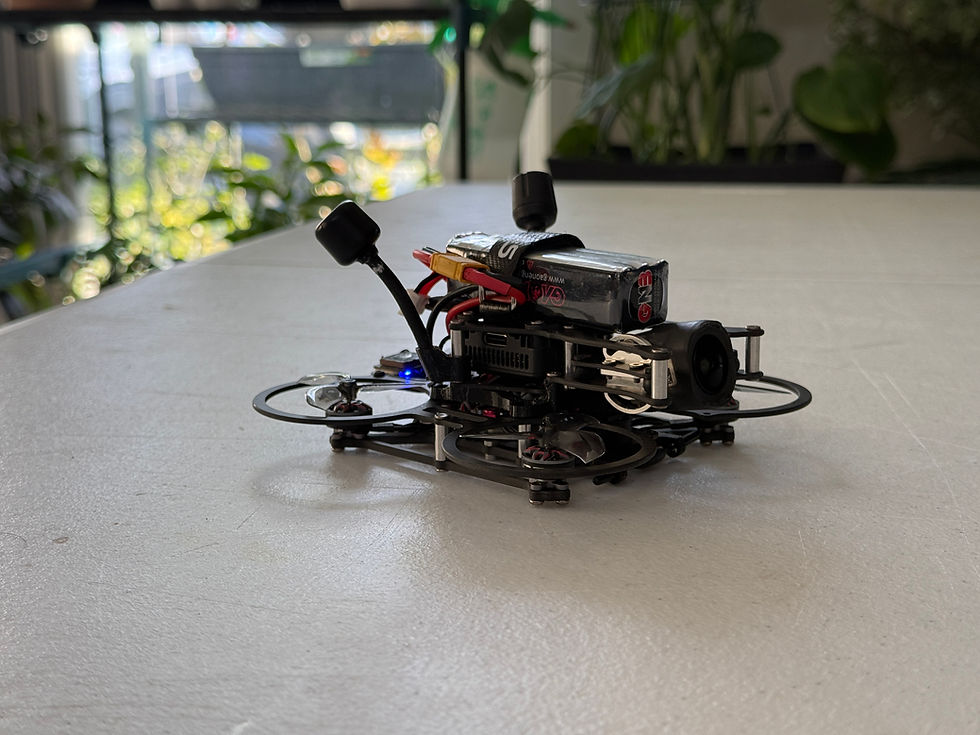
For indoor event work, whoops and cinewhoops are the right tool, and we run two depending on the room.
For tight spaces and close-to-crowd work, it's the BetaFPV Meteor75 Pro: a 75 mm brushless whoop that fits in your palm, weighs almost nothing, and has fully ducted props. It's not knocking anyone's drink over, and a wall tap is a non-event. We pair it with the DJI O4 Air Unit Lite for a reliable digital feed and usable onboard footage without going full-size.

For bigger rooms and hero shots, we step up to the Spydr ITSY-EVO, a cinewhoop we built around the DJI O4 Air Unit Pro on 45 mm ducted props. The O4 Pro's larger sensor and an ND filter kit give us footage that cuts cleanly alongside our main cameras, and the build is tuned to throw a flip mid-shot and recover without losing the line. That's the moment that gets a reaction on the dance floor. We carry a stack of small 3S packs so swaps between sets take seconds.
Low-light performance on a properly tuned whoop with a good digital stack is genuinely impressive for the form factor, and that's most of what event lighting throws at you.
One important caveat: whoops fly nothing like consumer drones. The control feel, the physics, the tuning: it's a different discipline. If your only FPV experience is an Avata or a DJI FPV in normal mode, you are not ready to fly a manual whoop around a crowd.
The path to indoor event FPV looks like this:
Sim time. Put real hours into a sim like Liftoff: Micro Drones or VelociDrone before you touch hardware.
Outdoor practice. Open spaces, learn the aircraft, crash without consequences.
Indoor practice. Empty venues, warehouses, spaces with nobody in them.
Low-stakes events. Small gatherings, controlled shoots.
Full event production. Only once you're consistently smooth and your situational awareness is sharp.
Skipping steps doesn't make you bold. It makes you a liability.
Insurance: Non-Negotiable
Indoors or out, carry liability insurance. Most event producers and venues will ask for a certificate before you set up a single shot. In our experience $2M is a reasonable floor and $5M is common for larger festivals.
If you're being paid, personal or recreational drone coverage won't cover you. Get commercial drone liability. It's cheap relative to what a single incident could cost.
The Bigger Picture
The Canadian event and entertainment drone space is still young enough that how we operate now shapes how regulators and clients see the whole profession for years.
Every pilot who shows up without an SFOC, flies the wrong aircraft over a crowd, or skips the safety docs because "it's just a small gig" makes it harder for everyone operating legitimately. It invites crackdowns, erodes client trust, and creates the incidents that end up in the news.
We've built our operation around doing this right: the certifications, the documentation, the right gear for every environment, the insurance. Not because it's the easy path, but because it's the only one that lasts.
If you're serious about event drone work, hold yourself to that standard.
Keep reading

DIRXECP is a Winnipeg-based commercial video production company specializing in music videos, events, corporate, and advanced drone/FPV production. We hold a Transport Canada Advanced RPAS Certificate and a Canada-Wide SFOC.
Questions about drone compliance or event production? Reach us at contact@dirxecp.com.
Sources: Transport Canada: Flying your drone at an advertised event · Transport Canada: Microdrones · Transport Canada: 2025 summary of changes


Comments